

Are you considering to switch to WP Engine Hosting to host your website? (Or skip the setup entirely with our managed hosting and maintenance plans.)
If you are, I can only congratulate you in advance, because I know that you will not regret this decision. After one of my clients introduced me to WP Engine Hosting few years ago, I was hooked immediately and switched all of my Wordpress Environments to WP Engine.
Since then, if anyone is looking for the best hosting provider available, I would always recommend WP Engine because there’s really no other logical choice to choose from. To those who are slightly budget conscious, you can always start with SiteGround for the first year, but eventually, I will still recommend them to move to WP Engine.
If you are reading this post, you probably are already on the fence. You know or have heard of the great service and support that WP Engine provides, the last piece of the puzzle is how fast it performs, before you jump in and make the investment.
In this article, I will cover the Speed Test Results I got from Google PageSpeed Insights tool, with various configurations, all while using WP Engine Hosting.
Quick Answer: How Fast Is WP Engine?
When I tested WP Engine in 2022 with Google PageSpeed Insights, and no optimisation plugins at all, these were the scores:
| Setup (Tested In 2022) | Mobile | Desktop |
|---|---|---|
| Default WordPress theme (fresh install) | 100 | 100 |
| Astra starter template (Steak House) | 91 | 98 |
| Elementor Pro template on Hello theme (Insurance) | 73 | 97 |
In short: WP Engine itself is fast, and the theme or page builder you put on it decides most of your score. I have not re-run this test since 2022, so treat these as 2022 numbers. Below you will find the full test, the current WP Engine plans and pricing (as of November 2026, including Atlas), and how to run the same test yourself.
WP Engine Hosting Speed Test Results
I ran these tests in 2022, when I first published this post. PageSpeed Insights has changed since then, so a new test today will not give exactly the same numbers.
For each of the test, I will be loading up the most common setup templates, and apply no further optimizations. What you see would be what you get directly from WP Engine. I will let you know which template I used, and the results I got for both Desktop and Mobile.
Let’s begin!
Speed Test With Wordpress Default Template (Fresh Install)
For the first test, I will just be using the Default Wordpress install which is the “Twenty Twenty”, “Twenty Twenty One” or “Twenty Twenty Two” theme.
With this theme, we can test the speed of the WP Engine servers out of the box, before adding any other bloat that comes with more complicated themes.
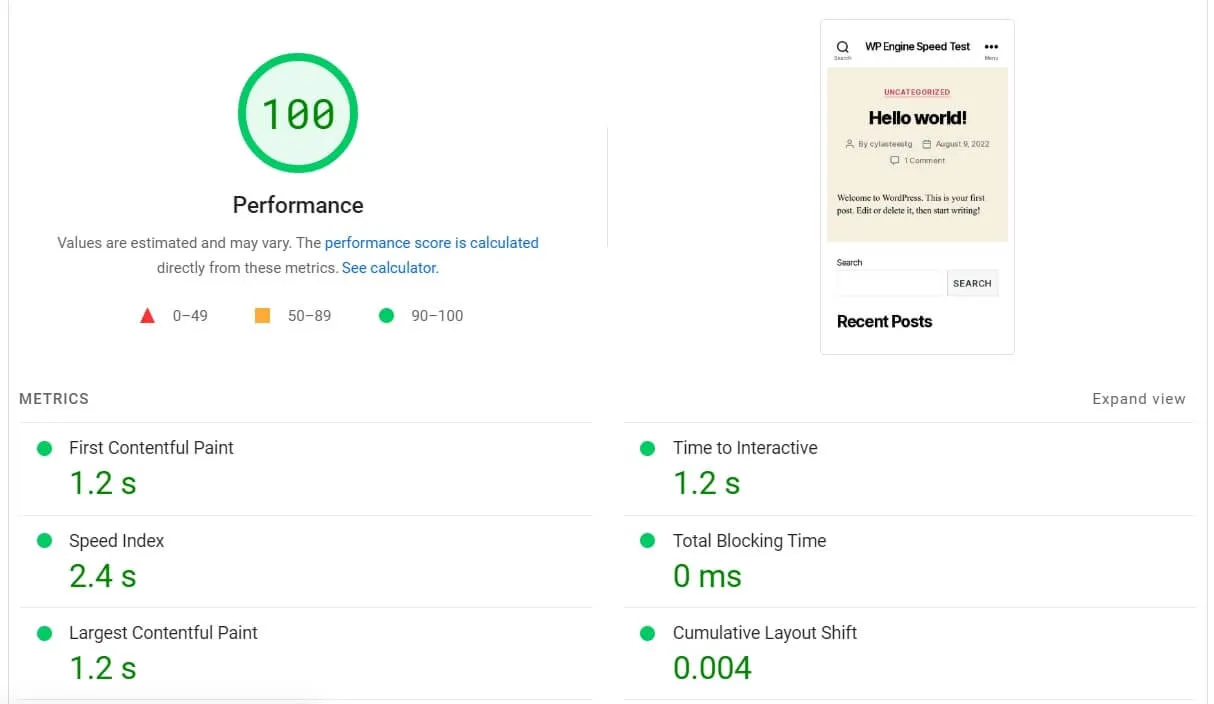
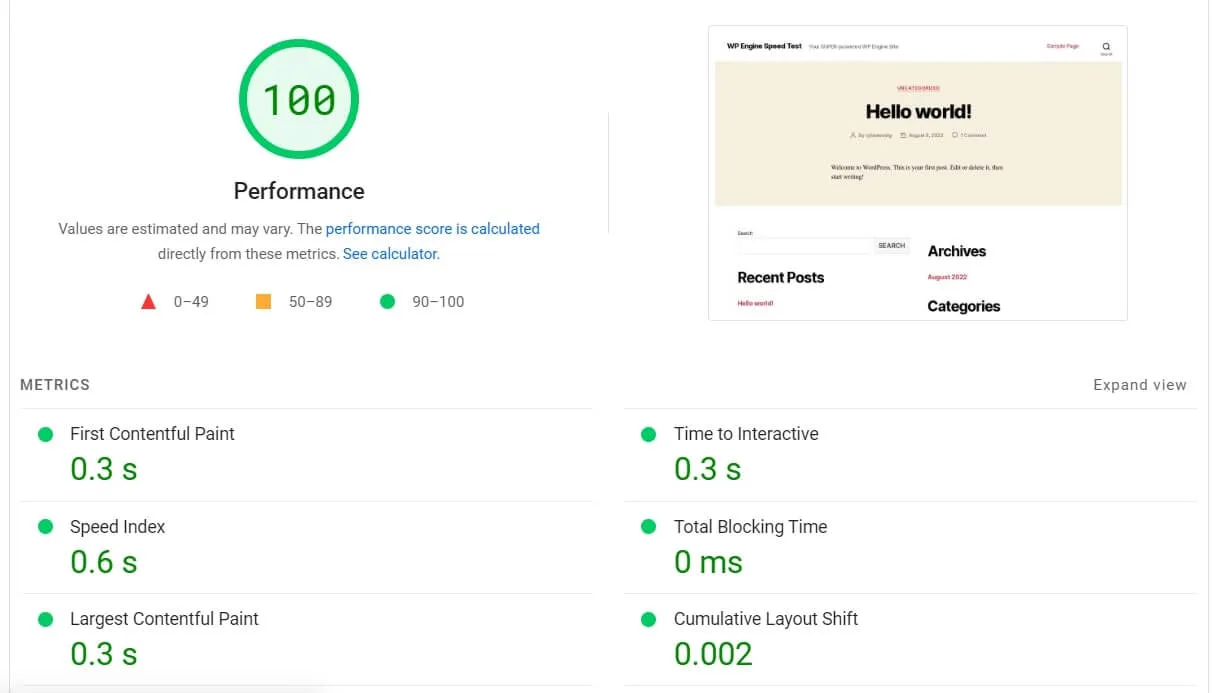
With the basic installation loaded, You can see that we are getting 100 for both Mobile & Desktop, which is not surprising knowing that there are no bloat. This shows that WP Engine comes with perfect score out of the box.
Note that this result is also the same for an installation with an Empty Astra Theme, because well… the website is empty and Astra is generally a clean theme, so I am not creating a new section just to test the speed of an empty Astra Theme.
Speed Test With Astra Starter Template
For the second test, I will be testing WP Engine’s speed when loading one of the Astra Starter Template. The reason why I choose Astra Starter Template (Steak House Theme) is because:
- Astra is a clean and popular base theme.
- Astra already have premade websites, so I don’t need to develop one just for testing.
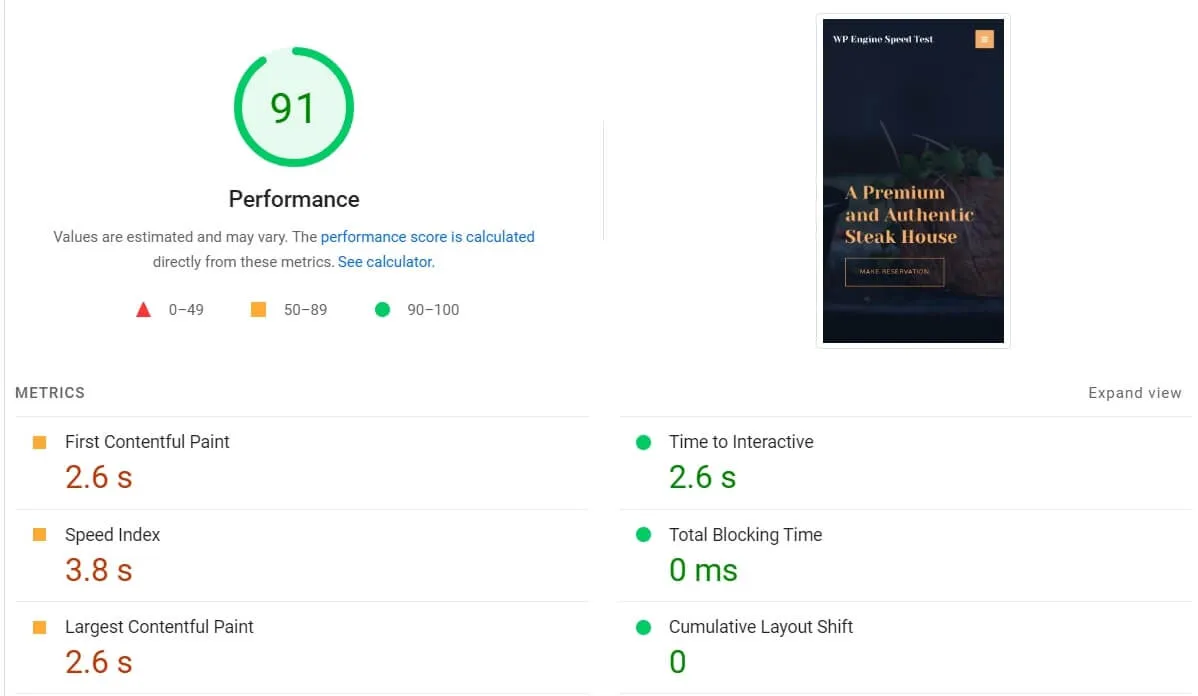
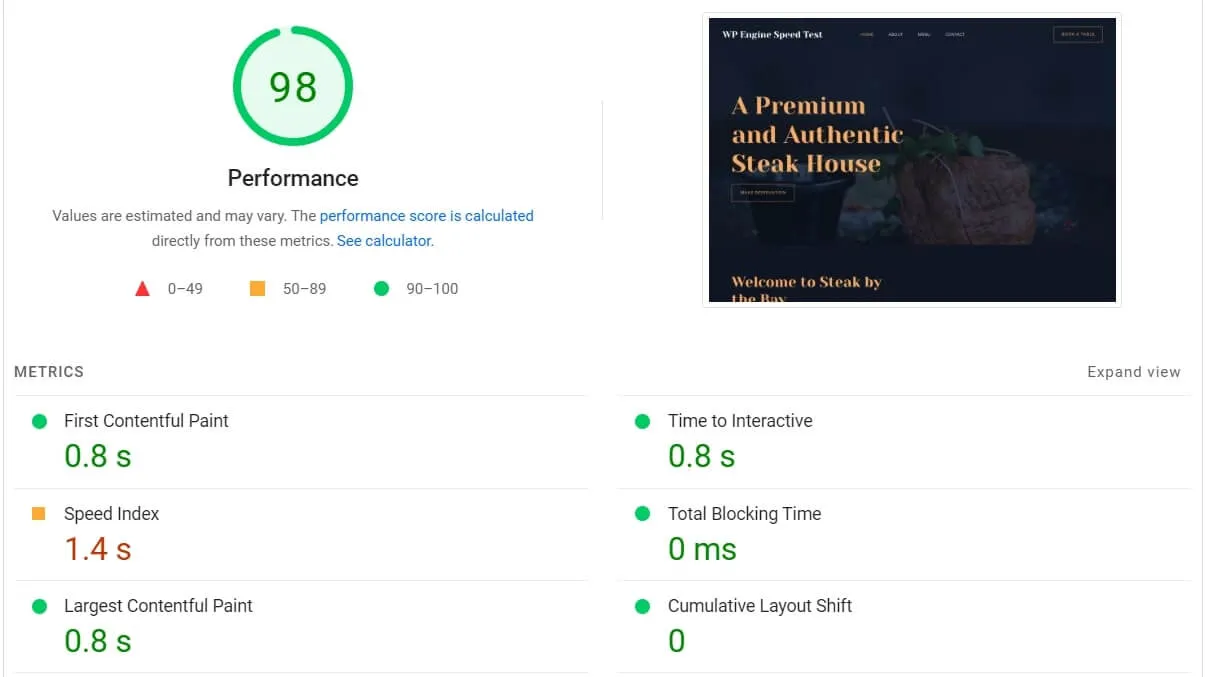
With the “Steak House Theme” loaded, and with no additional optimization. We can see that the page loads at 91 for Mobile and 98 for Desktop. This is pretty good, and I am sure with some really basic optimization, it could easily be 100 for both.
Note that this is a basic Astra installation with no Page Builders installed.
Speed Test With Elementor Pro Template
Now with basic installations out of the way, we are finally at where we are interested in.
The speed test with Page Builders! I have selected “Elementor Pro” as the choice here for the very same reason:
- Elementor Pro is an extremely popular Page Builder used by many.
- There are premade templates, so I don’t need to develop any for testing.
I have also removed the Astra Theme and installed the barebone Hello Theme by Elementor - to make sure the speed test is fair and not affected by the theme. The only plugins installed are also just Elementor and Elementor Pro.
I have also installed an Elementor Page Template provided in the Elementor Library.
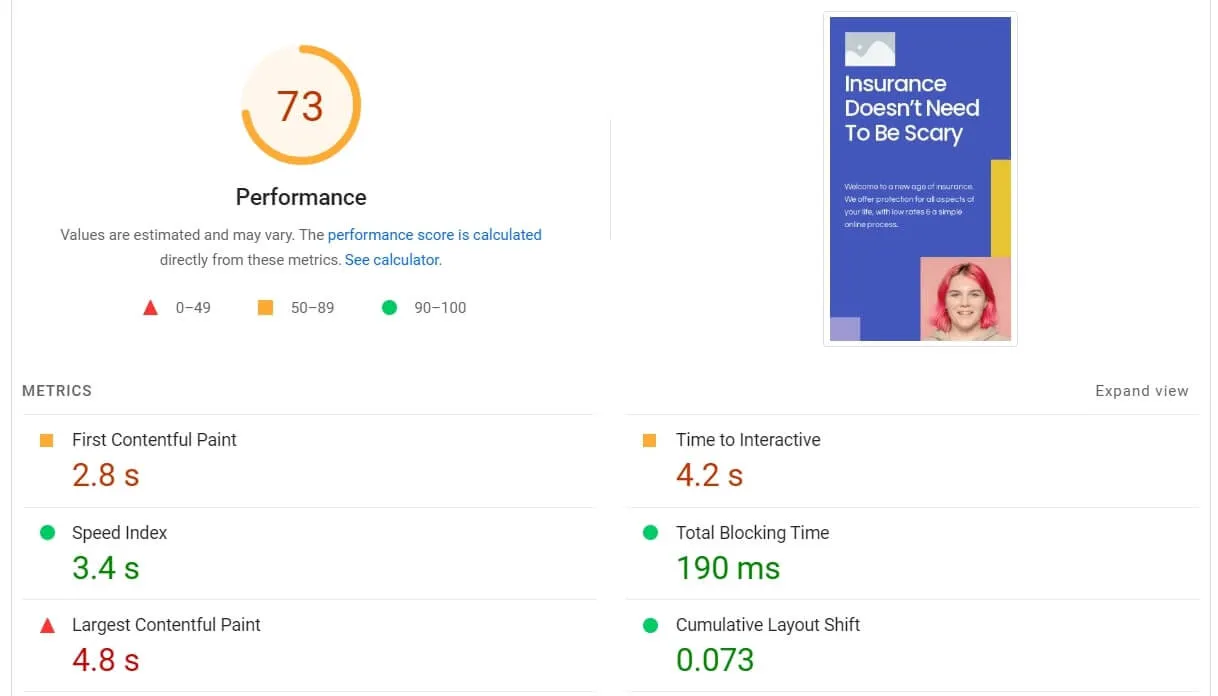
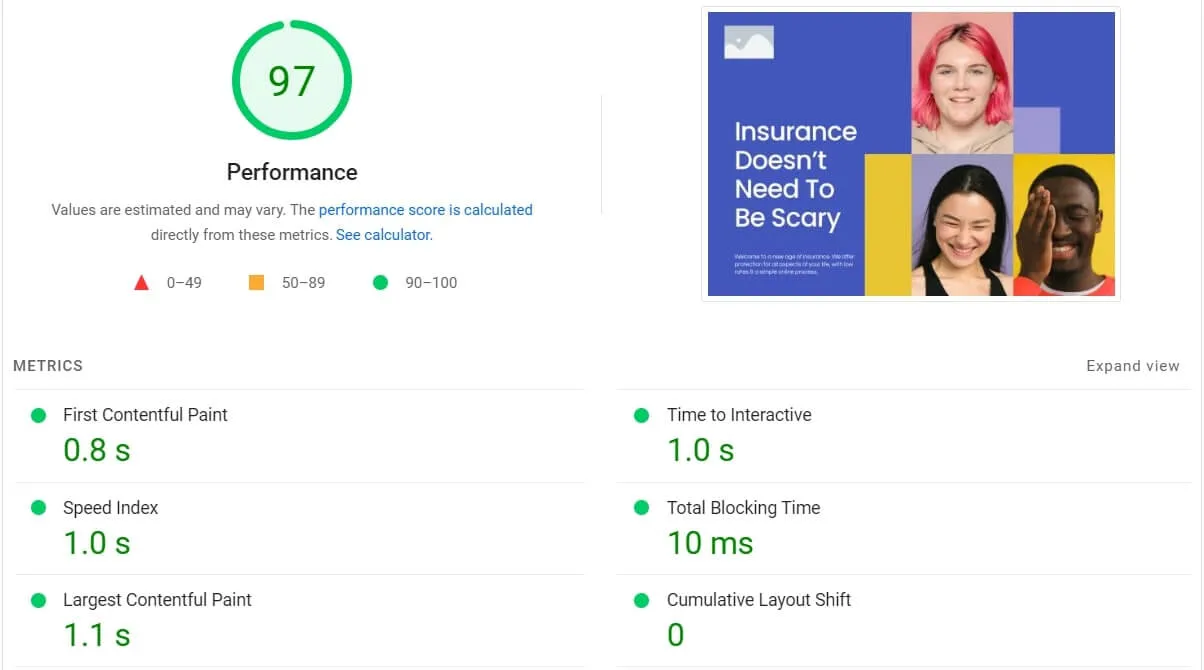
With the “Insurance Theme” installed, we can see that the desktop performance is at 97, which is honestly pretty good and surprising to me. The mobile speed is lagging behind a little at only 73.
Once again, these speed are calculation without additional caching or image optimization plugin, so that we can assess the speed of WP Engine Hosting most accurately.
With some basic optimization, i believe we can push Elementor Desktop speed to 100 and Mobile speed to possibly 90 + region.
If you would rather have an Elementor developer build the site and do that optimisation for you, that is what my Elementor developer services are for.
Should You Use WP Engine Hosting?
Based on the Speed Test above, I think its pretty fair to say that WP Engine performs pretty well in all the environments and infrastructure. With additional tweaks and more attention spent on page speed optimization tweaks, I think most websites won’t go wrong with WP Engine.
If budget is not a problem, I would strongly recommend you to use WP Engine Hosting. It’s the hosting provider I go to for all of my clients sites, and have 0 complaints so far.
WP Engine Plans And Pricing (As Of November 2026)
The plans have changed a lot since I ran the test. WP Engine now sells its shared hosting as one Essential plan with four sizes. These are the prices on the WP Engine plans page when I checked on 20 November 2026, in USD:
| Essential Plan Size | Visits/Month | Storage | Bandwidth | Billed Monthly | Billed Annually (First Year) |
|---|---|---|---|---|---|
| 1 site | 25,000 | 10 GB | 75 GB | $35/month | $336/year ($28/month) |
| Up to 3 sites | 75,000 | 15 GB | 150 GB | $65/month | $624/year ($52/month) |
| Up to 10 sites | 100,000 | 20 GB | 240 GB | $130/month | $1,248/year ($104/month) |
| Up to 30 sites | 400,000 | 50 GB | 550 GB | $330/month | $3,168/year ($264/month) |
A few things to know before you buy:
- The annual price includes a first-year discount for new customers on Essential plans. WP Engine says renewal pricing is subject to change, so expect to pay more from year two.
- Business starts at $400 a month, billed annually. You get isolated resources, phone support, managed migrations and a 99.99% uptime SLA.
- Enterprise is custom pricing through their sales team.
- The $13 Lite plan is not shown on the main pricing page. It has only ever been offered through a special pricing link, and I cover what it includes in my WP Engine Lite plan post.
WP Engine Discounts And Black Friday Deals
The easiest WP Engine discount is the one already on the pricing page: pay annually and your first year on an Essential plan costs less (for example $28 a month instead of $35 for one site, as of November 2026).
WP Engine has also run Black Friday and Cyber Monday sales in past years, usually extra free months on annual plans. As of 20 November 2026 they have not announced a 2026 Black Friday deal, so be careful with coupon sites claiming one. Black Friday this year is 27 November and Cyber Monday is 30 November. If a sale goes live, it will show on the WP Engine pricing page, so check there before you buy.
What Is WP Engine Atlas And How Is It Priced?
Atlas was the name of WP Engine’s headless WordPress platform. It is now called the WP Engine Headless Platform, and their support docs still say it was formerly named Atlas.
Headless means WordPress only manages your content, and a separate JavaScript front end (Next.js, React and the like) shows it to visitors. The Headless Platform hosts both parts: the WordPress backend and the Node.js front end, with tools like Faust.js, WPGraphQL and starter blueprints.
On pricing, as of November 2026:
- WP Engine offers Basic and Premium Headless Platform plans, with a free trial, but the prices are not published on their site. You click “Request Pricing” and talk to sales.
- There is a free sandbox account to learn and build on before you pay.
- When the headless plans launched in April 2022, WP Engine’s press release put them at $49 to $499 a month. Those prices are no longer listed, so don’t count on them.
For most small business sites, you don’t need headless at all. A normal Essential plan with a well built theme is fast enough, as the test above shows.
How To Run This WP Engine Speed Test Yourself
You don’t need to take my 2022 numbers for it. Here is how I ran the test, so you can repeat it on WP Engine (or any other host) today:
- Create a clean test site. On WP Engine, use a staging or development environment on its temporary domain, so you don’t touch your live site.
- Install one setup at a time. Start with the default WordPress theme, then a starter template, then your page builder template. Keep the plugins to the bare minimum.
- Don’t add any optimisation. No caching, image or minification plugins, so you are measuring the hosting and the theme, not the plugins.
- Run Google PageSpeed Insights at pagespeed.web.dev and record both the mobile and desktop scores.
- Run it three times and use the middle result, because scores move a few points between runs.
- Repeat the same setup on the host you are comparing. Same theme, same template, same plugins, otherwise the comparison means nothing.
Then add your optimisation plugins and test again, so you can see how much is the hosting and how much is the tuning.
Best Optimisation Plugin For WP Engine Hosting
If you are looking for ways to further optimize your website, here are my recommended plugins to further improve the speed of WP Engine. There are many plugins available, these are only the ones i use, and I would suggest you to give some of them a try.
The main 2 plugins i used would be WP Rocket for general optimization, and also Short Pixel Adaptive Image (SPAI) for any image optimization.
WP Rocket is an easy to use “set and forget” optimization tool that helps with both CSS/JS caching and minification. SPAI is a plugin that not only lazy loads the image, but also includes a CDN that delivers webp image with the correct size to mobile, which I think is extremely valuable.
Some people might not agree with WP Rocket, but this plugin was previously the only caching plugin recommended on WP Engine based on this article, so i have stuck with it since.
I am 100% sure there are newer and better speed optimization plugins out there, so if you disagree, you may give google search a try.
Is WP Engine The Best Hosting Provider?
Honestly..
I don’t think I can really answer this question, because there are many other hosting providers that I have not tried or tested. If you ask this question in the any WordPress Community, I am sure you will get a wide variety of answer.
If you are looking for my personal opinion, I indeed think that WP Engine is the Best Wordpress Hosting Provider you can find today. I have tried BlueHost, SiteGround, WPX Hosting and some more shady providers. None of them performs as well as WP Engine.
I can only suggest you to give it a try for one year. That’s all for this post, once again, if you have any questions, send me a message! For a deeper look at speed improvements, see our technical SEO service.